Olivia Brouillette
I'm a graduate student pursuing my PhD in Astronomy at New Mexico State University, with a B.S. in Mathematics and Physics. My research interests focus on computational planetesimal formation.
Research
- New Mexico State UniversityResearch AssistantFall 2024-Present
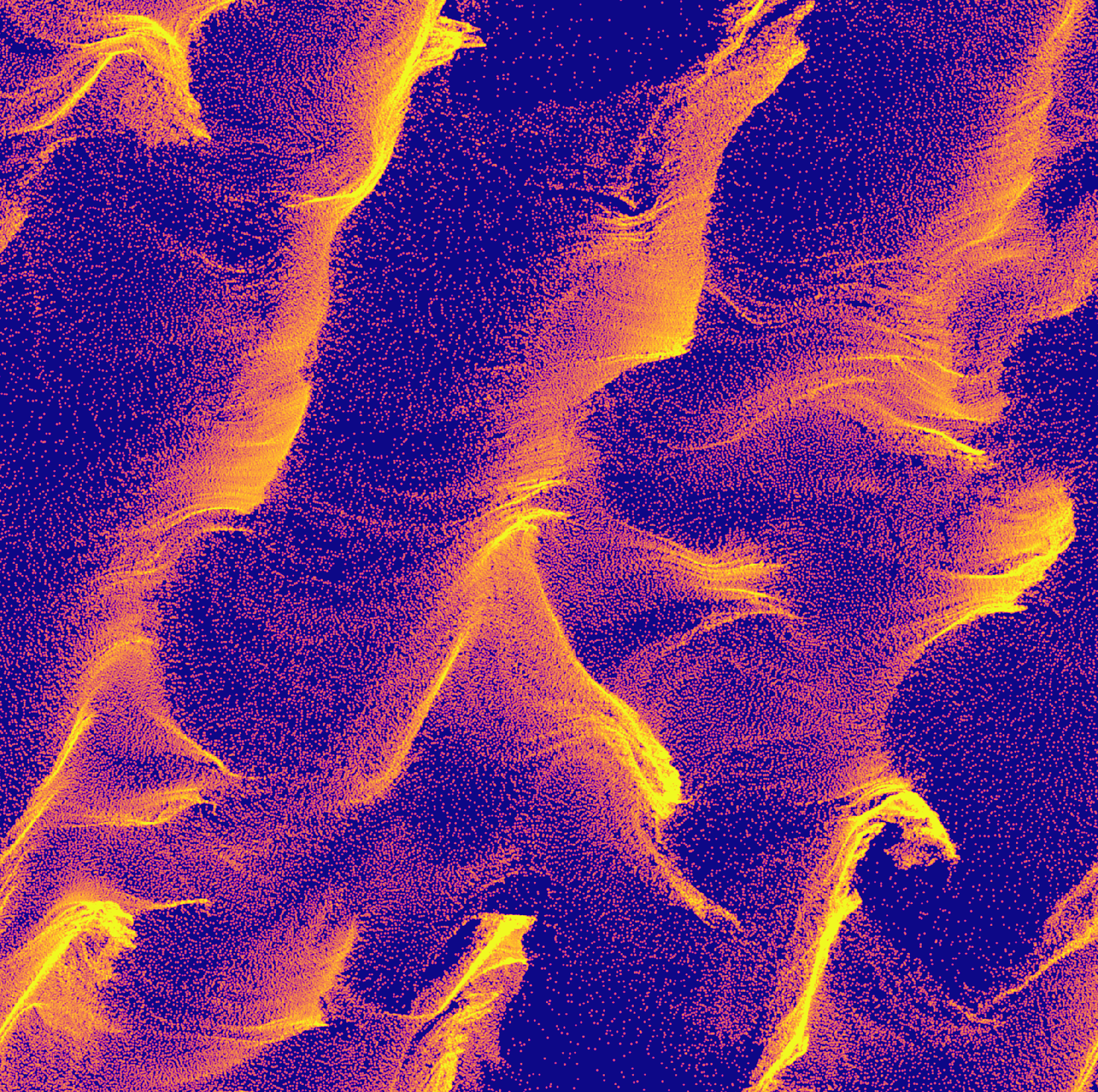
I have been working with Dr. Wladimir Lyra on the streaming instability using the Pencil code. My first project was part of a larger collaboration effort to compare the streaming instability across multiple hydrodynamic codes in an unstratified shearing box. The current project I am working on, as part of my planned thesis research, is determining strong clumping in streaming instability simulations based on the parameters given in the dispersion relation rather than the dust-to-gas surface density ratio, which has no physical interpretation. We hope that by using the dust-to-gas volume density ratio instead, we will be able to draw a clear path between the bifurcation seen in the dispersion relation at a dust-to-gas volume density ratio of order unity and what is seen in the simulations for the strong clumping regime of the streaming instability.
- Iowa State UniversityUndergraduate Research AssistantFall 2022-Spring 2024
I worked with Dr. Jacob B. Simon at Iowa State University, where we worked mainly in computational astrophysics, specifically in planet formation. We used high-performance computing and the Athena code to simulate planetesimal formation. We worked to determine the conditions for planetesimals to form via the streaming instability in a three-dimensional simulation. I focused on two parameters that determine the streaming instability efficiency: grain size and dust-to-gas surface density ratio (Z). Through this project, we aimed to establish conditions for planetesimal formation that were more realistic than previous studies. By varying these two parameters, we were able to determine a critical value of Z for which each grain size can potentially form planetesimals.
- Iowa State UniversityUndergraduate Research studentSummer 2021-Winter 2021
I worked in a group, led by Dr. Halil Ceylan, which explored the use of small Unmanned Aircraft Systems to inspect transportation infrastructure. I contributed in inspecting airport runways, aprons, and taxiways using pre-made drone operations, as well as generating 3D spatial data via Agisoft Metashape and ArcGIS Pro using the data.
Collaborations
- PFITS+ (Planet Formation in the Southwest +)
I am part of PFITS+, a collaboration of researchers studying the formation of planetesimals, from dust coagulation and pebble accretion to planetesimal formation through the streaming instability. The group recently ran multi-code comparison that benchmarks the streaming instability across hydrodynamic codes including Pencil Code, Athena, and Athena++. More on the collaboration can be found on the PFITS+ planet formation page.
Publications
Papers
- S.A. Baronett, W. Lyra, A. Hossam, O. Brouillette, Daniel Carrera, Victoria I. De Cun, Linn E. J. Eriksson, Mario Flock, Pinghui Huang, Leonardo Krapp, Geoffroy Lesur, Rixin Li, Shengtai Li, Jeonghoon Lim, Sijme-Jan Paardekooper, David G. Rea, Debanjan Sengupta, Jacob B. Simon, Prakruti Sudarshan, Orkan M. Umurhan, Chao-Chin Yang, Andrew N. Youdin, “A Comparative Study of the Streaming Instability: Unstratified Models with Marginally Coupled Grains (2026),” submitted to Astrophysical Journal, in review, Mar. 2026, doi:10.48550/arXiv.2603.04558.
- J. Lim, J.B. Simon, R. Li,O. Brouillette, David G. Rea, Wladimir Lyra,“The Streaming Instability in 3D: Conditions for Strong Clumping,” Sept. (2025)
- Md. A. A. Sourav, H. Ceylan, C. Brooks, D. Peshkin, S. Kim, R. Dobson, C. Cook, M. Mahedi, O. Brouillette... “Small Unmanned Aircraft System for Pavement Inspection: Task 4—Execute the Field Demonstration Plan and Analyze the Collected Data,” Nov. 2022
Outreach
- New Mexico State UniversityOutreach Coordinator 2025-PresentOrganize volunteer work for NMSU astronomy students with the local community.
Contact
Department of Astronomy
Office #107
New Mexico State University
Las Cruces, NM 88001
ob1@nmsu.edu
763-999-0768